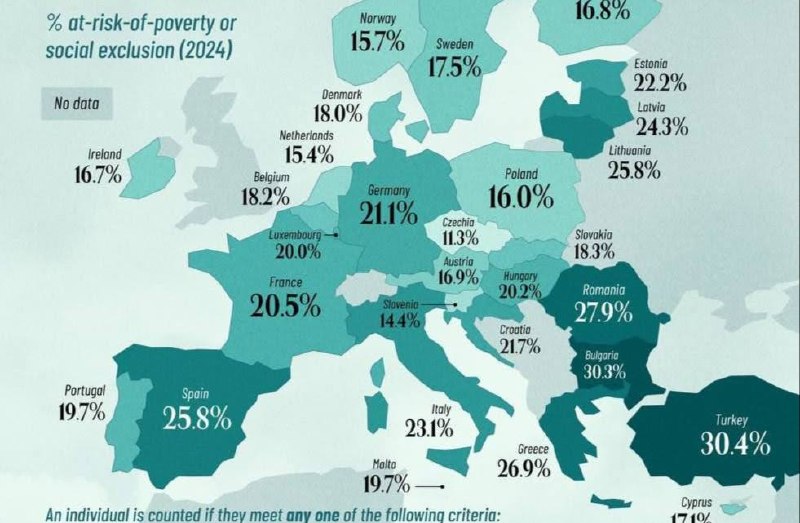
In which European countries are the most people at risk of poverty?
Europe is not just about high wages and social security. In some countries, a significant proportion of the population faces low incomes, inequality and the risk of social exclusion.
📊 Top 10 European countries by the proportion of the population at risk of poverty or social exclusion:
🇹🇷 Turkey – 30.4%
🇧🇬 Bulgaria — 30.3%
🇷🇴 Romania — 27.9%
🇬🇷 Greece — 26.9%
🇪🇸 Spain — 25.8%
🇱🇹 Lithuania — 25.8%
🇱🇻 Latvia — 24.3%
🇮🇹 Italy — 23.1%
🇪🇪 Estonia — 22.2%
🇭🇷 Croatia — 21.7%
On average across the European Union, 21 per cent of the population — around 93.3 million people — were at risk of poverty or social exclusion. (European Commission)
📉 Lowest rates in the EU:
🇨🇿 Czech Republic — 11.3%
🇸🇮 Slovenia — 14.4%
🇳🇱 The Netherlands — 15.4%
🇵🇱 Poland — 16.0%
🇮🇪 Ireland — 16.7%
🇫🇮 Finland — 16.8%
🇦🇹 Austria — 16.9%
🇨🇾 Cyprus — 17.1%
🇸🇪 Sweden — 17.5%
🇮🇹 Italy — 23.1%
Consequently, approximately one in four people in Italy were at risk of poverty or social exclusion. However, the situation varies greatly from region to region: for example, in Calabria, this figure stood at 37.2% in 2024 — one of the highest rates among EU regions. (European Commission)
🇺🇦 And what about Ukraine? Ukraine is not included in the Eurostat rankings as it is not an EU member state. According to World Bank estimates, the poverty rate in Ukraine last year stood at around 37 per cent, which is significantly higher than pre-war levels. In 2021, the figure was estimated at around 20 per cent. (The World Bank)
⚠️ Important: the ‘risk of poverty or social exclusion’ indicator is not simply the number of people with an income below a certain threshold. It takes into account several criteria, including low income, severe material and social hardship, or very low labour intensity.
💶 WHAT SHOULD THE MINIMUM INCOME BE IN EUROPE?
This figure is often referred to as the ‘subsistence minimum’, but officially Eurostat uses the term ‘at-risk-of-poverty threshold’. It is equal to 60 per cent of the median income in a given country. In other words, a person whose income is below this level is statistically considered to be at risk of poverty.
📊 At-risk-of-poverty threshold for a single person, € per month:
🇱🇺 Luxembourg — €2,540
🇩🇰 Denmark — over €1,600
🇦🇹 Austria — over €1,500
🇮🇪 Ireland — over €1,500
🇳🇱 Netherlands — over €1,400
🇧🇪 Belgium — over €1,300
🇩🇪 Germany — €1,381
🇫🇷 France — €1,278
🇮🇹 Italy — €1,030
🇪🇸 Spain — €965
🇵🇱 Poland — around €700
🇵🇹 Portugal — less than €750
🇬🇷 Greece — less than €750
🇭🇷 Croatia — less than €750
🇱🇹 Lithuania — less than €750
🇸🇰 Slovakia — less than €750
🇭🇺 Hungary — less than €500
🇷🇴 Romania — less than €500
🇧🇬 Bulgaria — €391
🇪🇺 EU average — around €1,079 per month.
⚠️ But it’s important to note: this doesn’t mean that €1,079 is enough for a comfortable life. The figure reflects the relative level of income within a country and does not take into account the actual cost of rent, food, transport and other expenses.
For example, the threshold in Italy is around €1,030, but in Milan, Rome or Naples, housing costs can account for a significant proportion of this amount.